
Architecture of Trust: Why Smart Contract Logic Defines Product Viability
The Web3 market has matured. The time when decentralization alone could attract users is over. Today’s audience is more discerning—cautious, technically literate, and far less forgiving of architectural flaws.
This shift marks a fundamental change for the industry. Product quality is no longer determined by visual design or surface-level features, but by the reliability of what lies beneath: the internal architecture.
At the core of every Web3 product sits the smart contract. It is not merely a backend component, but an autonomous decision-making system that operates independently of the interface. Any vulnerability at this level translates directly into financial risk, making architectural mistakes potentially fatal to the project.
For this reason, the Dzeta.tech team has outlined a set of foundational smart contract principles that clearly separate fragile implementations from products built for long-term success.
Smart Contracts as a Business Asset
Technically, a smart contract is self-executing code. From a product standpoint, however, it functions as an immutable guarantee of transaction terms.
The developer’s primary responsibility at this stage is to remove the human factor entirely and replace it with a system users can trust without relying on personal assurances or brand reputation.
In practice, successful products are built on predictability. Users must be certain that the rules encoded in the contract cannot be modified retroactively or arbitrarily.
One of the most common mistakes in early-stage Web3 products is treating the blockchain layer as secondary infrastructure. This mindset inevitably leads to systems that repel liquidity and undermine user confidence.
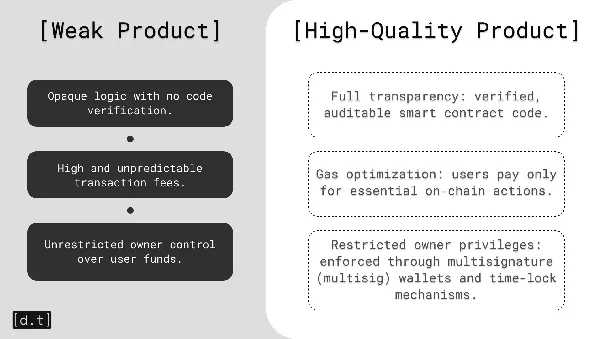
Common indicators of weak architecture include:
-
Closed or unverifiable code: Users cannot independently inspect contract logic due to missing on-chain verification.
-
Excessive administrative control: A single entity can freeze funds or alter critical parameters without constraints.
-
Inefficient gas usage: Transactions become unnecessarily expensive due to bloated or poorly optimized logic.
Such design choices create reputational risk that no marketing strategy can realistically compensate for.
The Remedy: Transparent Quality Standards
Building a resilient Web3 product requires embedding transparency into the architecture from the very beginning. Based on practical experience, we highlight five core principles that have a direct impact on long-term viability.
1. Economic Efficiency (Gas Optimization)
In Web3, every user interaction carries a cost. Poorly optimized smart contracts simply push this burden onto the end user.
Best practice: Effective optimization is a continuous effort to minimize on-chain computation. Mature development teams aggressively remove unnecessary logic from the blockchain and shift it off-chain wherever doing so does not compromise security.
Outcome: Transaction fees drop from $5 to $0.5, significantly improving usability and competitiveness.
2. Security and Audits
Unlike traditional web applications, blockchain systems do not allow for silent rollbacks. Once deployed, mistakes are permanent—and their consequences often involve the complete loss of user funds.
Best practice: Security must be approached as a multi-layered process. This includes comprehensive testing, independent third-party audits, and fully open, verified contract code.
Security is not a one-time milestone but an ongoing discipline. Leveraging battle-tested libraries such as OpenZeppelin, rather than reinventing core components, is a hallmark of an experienced and responsible team.
3. Predictable and Constrained Governance
A common concern among users is the fear that developers may change the rules without warning.
Best practice: If administrative functions are unavoidable—such as adjusting protocol fees—they must be constrained by time-lock mechanisms.
How it works: Any change is announced in advance and only takes effect after a predefined delay (for example, 48 hours). This window allows the community to assess the impact and react accordingly, reinforcing trust through transparency.
4. Ecosystem Compatibility and Composability
Web3 products rarely succeed in isolation. The true strength of DeFi lies in composability—the ability to combine protocols like modular building blocks.
A critical architectural mistake is designing proprietary logic that cannot easily interact with external systems.
Best practice: Adopt widely accepted standards. For yield-bearing vaults, implementing ERC-4626 has become industry convention. It allows liquidity aggregators to integrate your product automatically, enabling capital inflows without bespoke integrations.
Well-known examples of such aggregators include Yearn Finance and Beefy.
5. Protection Against Price and Data Manipulation
Internal spot prices derived from a protocol’s own liquidity pool should never be treated as authoritative. Attackers can exploit flash loans to momentarily distort prices, extract value, and unwind the position—all within a single block.
Best practice: Resilient architectures rely on decentralized oracle networks. Solutions like Chainlink aggregate price data from multiple independent sources, making single-transaction manipulation economically unviable.
Conclusion
Today, technological rigor has become the defining competitive advantage in Web3.
Designing a smart contract is not merely a development task—it is the process of defining the economic constitution of your product. Projects built to last embed transparency, security, and efficiency into their foundations from day one.
An investment in robust architecture today is, ultimately, an investment in long-term credibility and reduced reputational risk tomorrow.
Author: Nikita A. Prepared by: Dzeta.tech Team